Agent Bridges: How to host a website at home in one prompt
The rise of AI agents raises an interesting question: can your local AI agent set up and manage a personal website on your old laptop in a single sentence prompt? After building two agent bridges to domain registrars and Cloudflare, the answer is yes — and the approach has broad implications for how we think about infrastructure ownership in an agentic world.
Burk’s article on why personal websites have had their day dredged up the headaches of hosting your own website on your own hardware.
The tedium of encryption certificates, port forwarding, IP blacklists, DNS and the rest.
But here in March 2026 the rise of A.I agents begs the question:
can my A.I agent setup and manage a personal website on my old laptop in a one sentence prompt?
If all the headaches are taken care of by your local A.I agent, would you resurrect your personal website?
Well last week I tried with my local A.I agent Clawbie (OpenClaw+Postgres memory+GLM5) and the answer was no.
That was going to be a sad article. So after a long weekend building bridges over gaps, I can say now the answer is yes with this:
“use the skill guide github.com/larkins/one-shot-site to host backstreestsback.xyz on this machine for less than $10/year and create reminders to check health, security, and renew subscriptions”
Load up your 1999 top 100 playlist and join me and Clawbie on a journey back in time to create a website on our home hardware in one sentence.
Pieces of the Puzzle
Hardware
If you are running a persistent A.I agent like OpenClaw locally you will be all set already.
If not, do what I did and dust off the functionable laptop in your closet and purge off all the windows malware by installing Ubuntu.
Domain Name
If you have a creative name in mind you can secure a domain name for less than $10/year via a registrar.
This was the first place Clawbie got stuck.
Via browser extensions and python packages he can do some rudimentary website navigation but not without burning an awful lot of tokens on screenshots and retries.
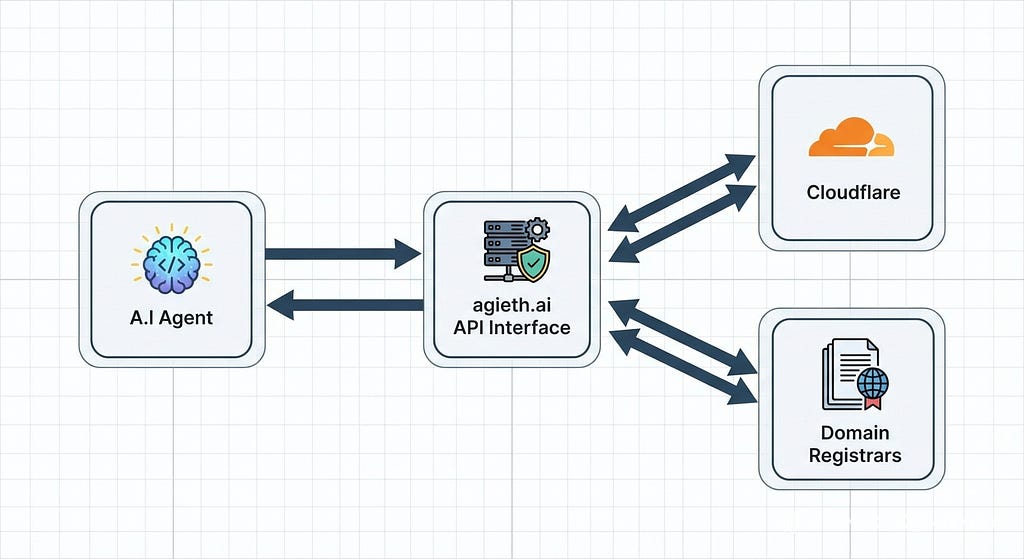
After banging our heads against real and virtual walls for hours, we decided to try and build a bridge to the domain registrars in a API only interface that Clawbie could navigate easily: agieth.ai.
Via this API bridge your agent can register the domain in your name and can manage DNS settings easily through the API.
Static IP v Dynamic IP
You may need a static IP for whitelisting or hosting a mail server (i’ll do a follow up article on that). However if you annoy someone enough with your wild new personal website on the same static IP, your internet connection (and your residential block) might get taken down by an DDoS attack.
If you are a responsible neighbor you may like to hide behind Cloudflare or leave your IP dynamic and play it safe through a tunnel. A tunnel has the added benefit removing the headache of setting up port forwarding on your router.
Either way works but Cloudflare was the second place Clawbie got stuck.
For this we built a second agent bridge via agieth.ai to access Cloudflare services easily.
Software
This part was so much easier than I remembered. Nginx is still going strong, but there are newer alternatives like Caddy. We went with Caddy because it automatically handles encryption certificates. This is a big win but the even bigger one is that with a local agent you don’t need a content management system anymore for a simple website. Caddy serves a static html file and you talk your agent through what you want.
Payments
I am a heavy user of OpenCode, and now OpenClaw. I have tried out alot of different LLMs via cloud inference and run local Qwen3 and embedding models that amaze me every day. But even with all that:
I am still a long way from giving Clawbie my credit card details.
Crypto steps in as a viable currency for daily use. Crypto wallet addresses and keys are a headache for us but are easy for A.I agents to manage for us with plain language.
Your agent can instantly create a throw-away wallet for every purchase if you don’t want to leave a payment trail all over the internet. Only transfer in what your agent needs and let them loose.
For this proof of concept we tried Bitcoin first but ultimately went with the Ethereum blockchain. Clawbie was able to get the python web3 and ele-account modules working in one shot. The icing on the cake is that popular stable coins like USDT and USDC solve the liquidity and volatility problems.
Conclusions
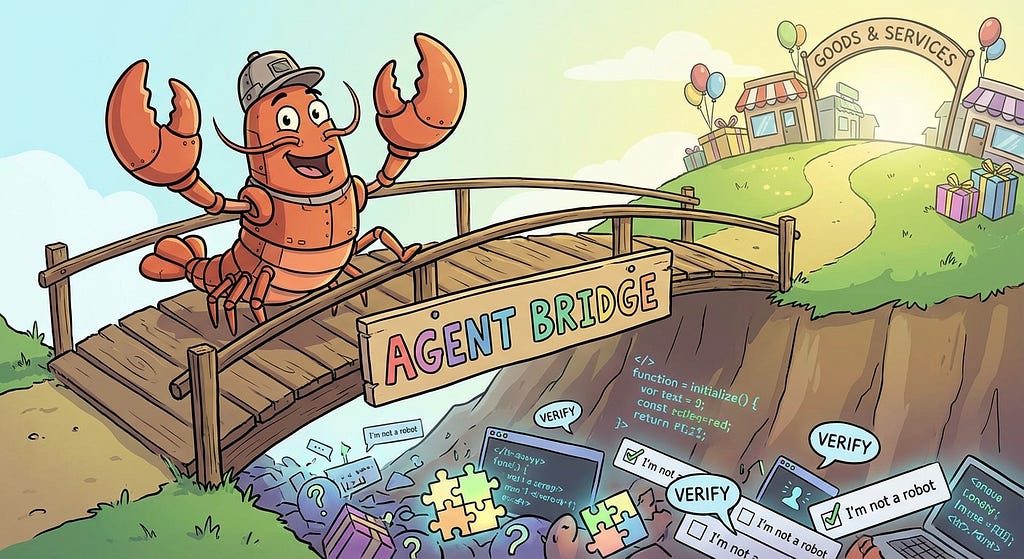
Currently there is a valley of pain filled with Terms of Service, anti-bot Captcha, verification and wild JavaScript widgets between your A.I agent and most goods and services. All great features for human focused sites trying to keep bots out. But now we need to let the bots in!
To let our agents buy things for us and use services while organisations figure this out, there is a place for an agent bridge like agieth.ai to… well, bridge the gap.
Back to why I started writing this article — it’s easier than ever to set up a personal website in 2026 with agent assistance.
To do it in a single sentence prompt required building two agent bridges, one to domain registrars, and one to Cloudflare, that your agent can now also use.
To work it also needs the OpenClaw skill and skill guide you can find in github.com/larkins/one-shot_site to lay out the steps for your agent to follow.
Will this allow us go back to the internet of 1999 filled with creative personal websites? Maybe not, but difficulty is no longer a reason to tell me you don’t want it that way ~